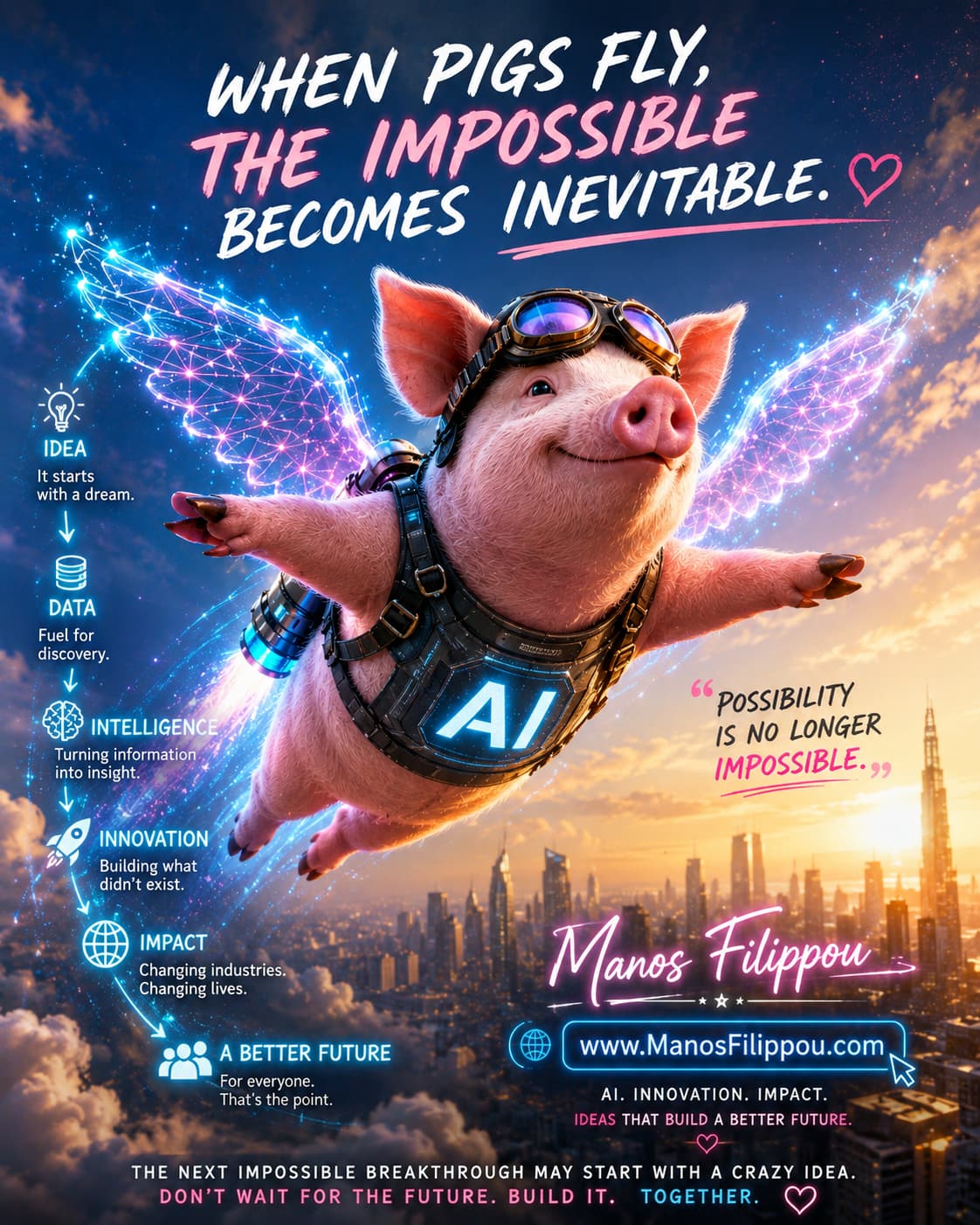
The headline is now official:
Elon Musk has become the world's first trillionaire.
A trillion dollars.
A number so large that it almost stops meaning anything at all.
But the real story isn't the trillion.
The real story is probability.
Many of Musk's ventures were once considered unlikely to survive. Rockets exploding on launch pads. Electric cars dismissed as niche products. Reusable boosters called impossible. Colonizing Mars treated as science fiction.
Innovation rarely begins with certainty.
It begins with uncomfortable odds.
History teaches an inconvenient truth: the future is often built by people willing to bet on outcomes that most consider impossible.
Artificial intelligence may be the greatest example of this phenomenon.
AI is changing an ancient equation:
Impossible × Time × Intelligence = Reality.
For centuries, humans have used the phrase "when pigs fly" to describe something that will never happen.
But history has a sense of humor.
Humans flew.
Machines learned.
Cars drive themselves.
Algorithms paint pictures.
And software now writes words that once only humans could create.
Perhaps pigs do not need wings.
Perhaps they only need enough intelligence around them to invent flight.
That may be the true lesson of the AI era.
Artificial intelligence does not merely automate the possible—it expands the boundaries of possibility itself.
The next impossible breakthrough may already exist in prototype form.
The next trillion-dollar company may begin with an idea that investors laugh at.
The next revolution may look absurd—right up until the moment it works.
After all, every miracle is just an impossibility with a timestamp.
And history keeps proving that impossible things happen more often than we think.