More than 200 years ago, Mary Shelley wrote a story that was never really about monsters.
It was about creators.
It was about ambition.
It was about what happens when humanity builds something powerful before fully understanding the consequences.
Today, that story feels more relevant than ever.
Because we are becoming modern Dr. Frankensteins—assembling intelligent systems more powerful than anything humanity has ever created.
But do we truly understand what we’re building?
To understand modern AI, perhaps we should look backward before we look forward.
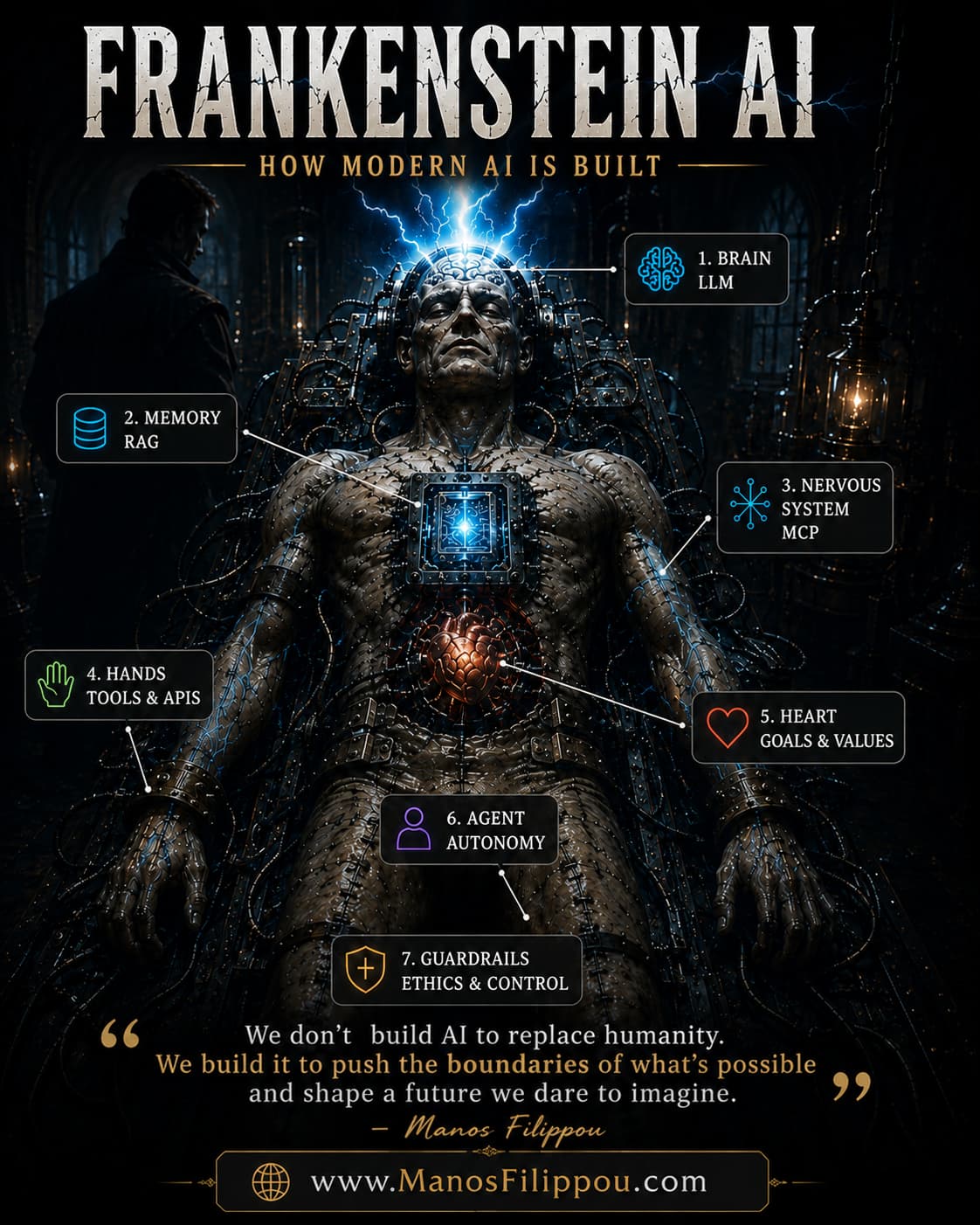
Let’s break down AI the way Dr. Frankenstein built his creature.
Large Language Models (LLMs) like ChatGPT, Claude, and Gemini are the brain.
They can reason.
They can write.
They can summarize.
They can analyze.
They can generate code.
They can solve problems.
But a brain alone isn’t enough.
A brain doesn’t know your company.
It doesn’t know your customers.
It doesn’t know your documents.
It doesn’t know your world.
A brain without memory is powerful—
but limited.
This is where RAG comes in.
RAG stands for Retrieval-Augmented Generation.
Think of RAG as memory.
It gives AI access to:
- Documents
- Databases
- Emails
- Internal wikis
- Websites
- Knowledge bases
Without RAG, AI relies only on what it learned during training.
With RAG, it can access your knowledge in real time.
The creature now remembers.
And memory changes everything.
A brain that thinks is impressive.
A brain that interacts with reality is transformative.
This is where MCP and tools enter the picture.
Model Context Protocol (MCP) acts like the nervous system.
It allows AI to connect with external systems and software.
Information flows in.
Actions flow out.
Signals travel across the body.
Without a nervous system, intelligence remains trapped.
With one, intelligence becomes connected.
Tools and APIs are how the creature interacts with the world.
They are its hands.
Its eyes.
Its senses.
They connect AI to:
- Slack
- CRMs
- Google Drive
- Databases
- Browsers
- Code interpreters
- Enterprise software
Now the creature can read.
Write.
Search.
Send emails.
Update records.
Trigger workflows.
Take action.
The creature no longer merely thinks.
It acts.
Every creature needs purpose.
You give it:
- Goals
- Rules
- Tone
- Priorities
- Values
- Constraints
This becomes its heart.
Its internal compass.
Because intelligence without direction is merely potential.
Purpose transforms capability into action.
When all these parts come together, something entirely new emerges:
An AI Agent.
The agent is not the brain.
The agent is the complete creature.
Brain + Memory + Tools + Objectives
Together they create a system that:
- Understands
- Remembers
- Connects
- Decides
- Acts
- Executes
A tireless digital worker.
Always on.
Always learning.
Always acting.
This is the part many people underestimate.
Guardrails are not limitations.
They are safety.
Permissions.
Boundaries.
Human oversight.
Transparency.
Ethics.
Accountability.
Without guardrails, power becomes risk.
With guardrails, power becomes progress.
The strongest AI systems of the future will not simply be the smartest.
They will be the safest.
He gave it power, but no guidance.
He gave it life, but no responsibility.
He expected it to be good without teaching it what good is.
AI is no different.
Give an agent access to your data.
Connect it to tools.
Allow it to make decisions.
And without the right guardrails, objectives, and oversight—
you haven’t built software.
You’ve created autonomy.
“I ought to be thy Adam, but I am rather the fallen angel.”
— Frankenstein’s Creature
✓ Define clear objectives
✓ Use the right data
✓ Connect the right tools
✓ Set strong guardrails
✓ Monitor and audit
✓ Evolve with responsibility
Build with power.
But always with purpose.
AI may become the most powerful creation in human history.
It can elevate humanity.
It can solve unimaginable problems.
It can unlock a future beyond anything we have ever dreamed.
But only if we build it with wisdom.
We are all becoming Dr. Frankenstein.
The question isn’t whether we can create intelligence.
The question is whether we are prepared to take responsibility for it.
Because every creator is ultimately judged not by what they build—
but by what they unleash upon the world.
— Manos Filippou