
How I Would Use AI to Reduce Manual Reporting by 60% for a B2B Team in 60 Days
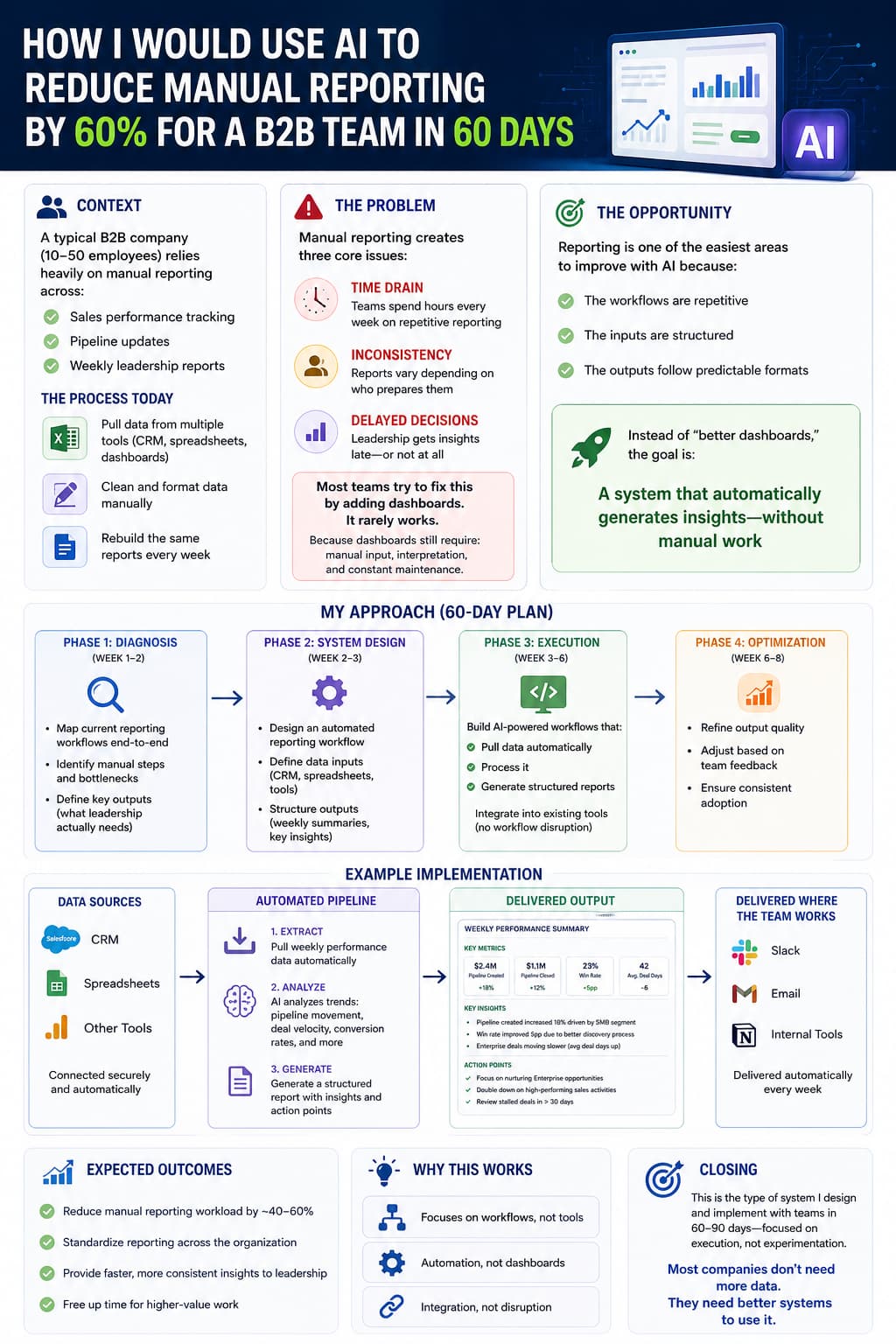
ContextA typical B2B company (10–50 employees) relies heavily on manual reporting across:
- Sales performance tracking
- Pipeline updates
- Weekly leadership reports
These processes usually involve:
- Pulling data from multiple tools (CRM, spreadsheets, dashboards)
- Cleaning and formatting data manually
- Rebuilding the same reports every week
The Problem
This creates three core issues:
- Time drain: Teams spend hours every week on repetitive reporting
- Inconsistency: Reports vary depending on who prepares them
- Delayed decisions: Leadership gets insights late—or not at all
Most teams try to fix this by adding dashboards.
It rarely works.
Because dashboards still require:
- manual input
- interpretation
- and constant maintenance
The Opportunity
Reporting is one of the easiest areas to improve with AI because:
- the workflows are repetitive
- the inputs are structured
- the outputs follow predictable formats
Instead of “better dashboards,” the goal is:
A system that automatically generates insights—without manual work
Phase 1: Diagnosis (Week 1–2)
- Map current reporting workflows end-to-end
- Identify manual steps and bottlenecks
- Define key outputs (what leadership actually needs)
Phase 2: System Design (Week 2–3)
- Design an automated reporting workflow
- Define data inputs (CRM, spreadsheets, tools)
- Structure outputs (weekly summaries, key insights)
Phase 3: Execution (Week 3–6)
- Build AI-powered workflows that:
→ pull data automatically
→ process it
→ generate structured reports - Integrate into existing tools (no workflow disruption)
Phase 4: Optimization (Week 6–8)
- Refine output quality
- Adjust based on team feedback
- Ensure consistent adoption
Example Implementation
For this company, I would:
- Connect CRM and reporting data sources
- Create an automated pipeline that:
→ extracts weekly performance data
→ analyzes trends (pipeline movement, deal velocity, conversion rates)
→ generates a structured report - Deliver output as: clean summary, key insights, action points
Delivered directly where the team already works (Slack, email, or internal tools)
Expected Outcomes
- Reduce manual reporting workload by ~40–60%
- Standardize reporting across the organization
- Provide faster, more consistent insights to leadership
- Free up time for higher-value work
Why This Works
Because it focuses on:
- workflows, not tools
- automation, not dashboards
- integration, not disruption
Most companies don’t need more data.
They need better systems to use it.
Closing
This is the type of system I design and implement with teams in 60–90 days—focused on execution, not experimentation.